Handball photography - finding meaning in motion
Handball is a game that allows little time for reflection. It unfolds in short, intense sequences of speed and contact, played out in indoor arenas where the light is rarely ideal and the rhythm of the game leaves little space for hesitation. To photograph it is to work slightly behind the action, always aware that the decisive moment has either just passed or is about to arrive, and that your task lies somewhere in that narrow space between the two. That space is not a limitation, but part of the medium, and for me, part of the charm.
Canon 1D X Mark III + Canon EF 200mm f/2.0L IS USM, 1/1600, f2.0, ISO3200
As with much of sports photography, the subject is not only the sport itself. What matters just as much is attention, or the ability to recognise when a routine movement, repeated dozens of times in a match, begins to carry weight and meaning. The challenge lies less in reacting quickly than in observing carefully, a challenge I find difficult. The great Peter Read Miller once spoke about the importance of photographing between moments, of looking beyond the obvious peak of action to what precedes it and what follows. Handball lends itself naturally to this approach. The expected images are always present: the airborne jump shot, the physical exchanges along the six-metre line etc. They describe the game clearly, but they rarely explain it fully.
Canon 1D X Mark III + Canon EF 200mm f/2.0L IS USM, 1/1600, f2.0, ISO3200
More often, it is the quieter images that remain, at least for me. A brief exchange of looks between players, a moment of thinking, a glance at the scoreboard, held a fraction of a second too long. A defender recognising, almost reluctantly, that they are late. These moments do not announce themselves, they cannot be forced, and they vary in each individual game. They depend on patience and on a willingness to let the game reveal itself rather than trying to extract images from it. The challenge for me is to rise above the obvious images, and find these moments in between.
From a technical perspective, conditions under which handball is photographed are not idea. Indoor arenas offer uneven lighting, mixed colour temperatures, and backgrounds crowded with advertising boards. There is no ideal light to wait for, only a set of constraints that must be worked within. In this context, technique becomes less about optimisation and more about consistency. Fast shutter speeds, never below 1/1000s, are necessary to contain the movement, often at the cost of light. Wide apertures help separate players from their surroundings, but depth of field becomes unforgiving. Not all shots are in focus with apertures ranging from f1.4-f2.0. High ISO, usually between ISO3200-6400, is unavoidable, and noise becomes part of the image’s texture rather than something to be eliminated entirely. Minor exposure compromises, grain, and edge blur are not signs of failure, but traces of the conditions in which the photograph was made. Luckily, the Canon 1D X Mark III excels at both autofocus and noise control.
Canon 1D X Mark III + Canon EF 200mm f/2.0L IS USM, 1/1600, f2.0, ISO3200
What matters more than technical refinement is anticipation. In handball, reacting is almost always too late. The game has a structure that reveals itself over time: players cutting along familiar lines, signalling their intentions through subtle shifts in posture, and goalkeepers committing to decisions long before the shot is released. The better this language is understood, the less the photographer depends on reflex and the more they can position themselves where the play is about to unfold. This familiarity with the game creates a sense of time, even within its speed. It allows the camera to be ready before the moment arrives, rather than chasing it as it disappears, because that chase is one that, at least I, will never win.
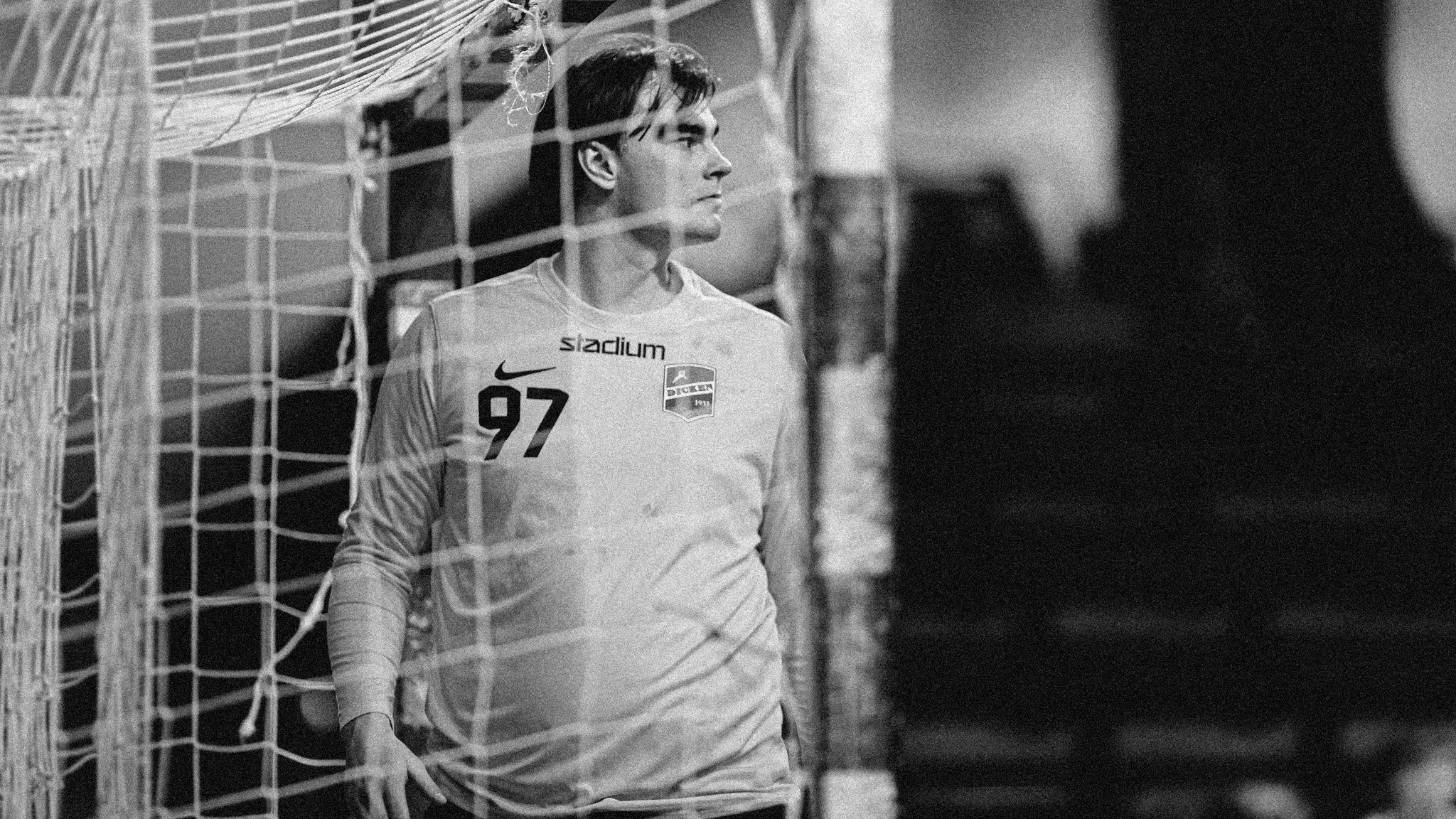
Canon 1D X Mark III + Canon EF 200mm f/2.0L IS USM, 1/1600, f2.0, ISO3200
After five years of photographing handball, the attraction has not faded. If anything, it has become quieter and more concentrated. The mechanics of the work no longer demand conscious attention: the camera, the settings, the exposure decisions all recede into the background, handled almost automatically through repetition and familiarity. This leaves space for something else. During a match, the work settles into a kind of flow, where technical choices happen without interruption and attention is directed almost entirely toward reading the game and waiting for the right image to surface. In that state, the task is no longer to operate the camera, but to remain present, patient, and receptive to recognise the moment when everything aligns on court.
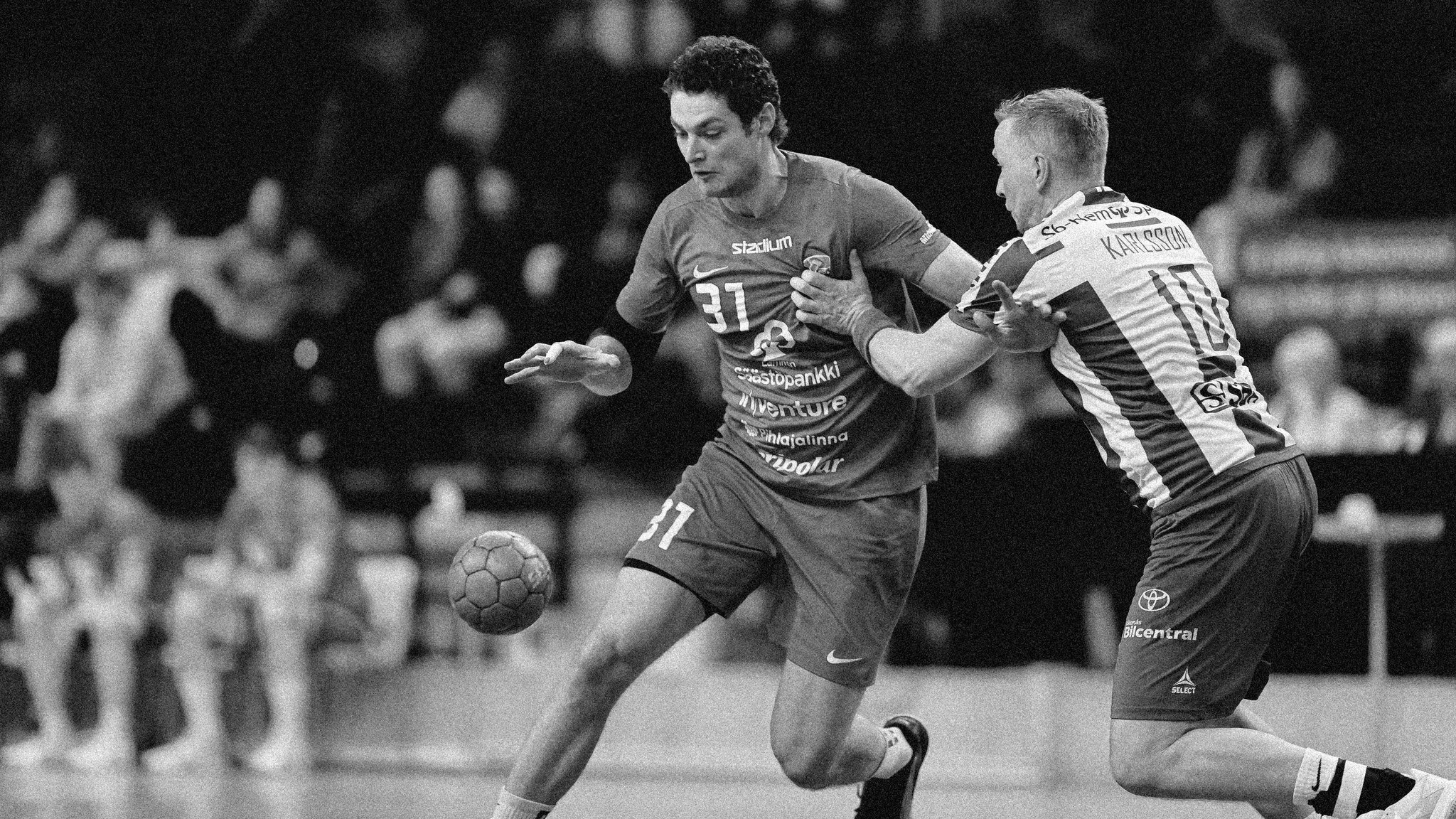
Canon 1D X Mark III + Canon EF 200mm f/2.0L IS USM, 1/1600, f2.0, ISO3200
While movement defines handball, faces give it meaning. Emotion appears immediately and without mediation. Concentration, frustration, relief and hesitation are visible within moments, often written clearly across a player’s face. A technically precise image of action carries limited weight if it lacks this dimension, while a less perfect frame, made at the right emotional moment, can communicate far more. At this point, the boundary between sports photography and documentary work becomes blurry. The aim is no longer to document what happened, but to blend it with how it felt for those involved.
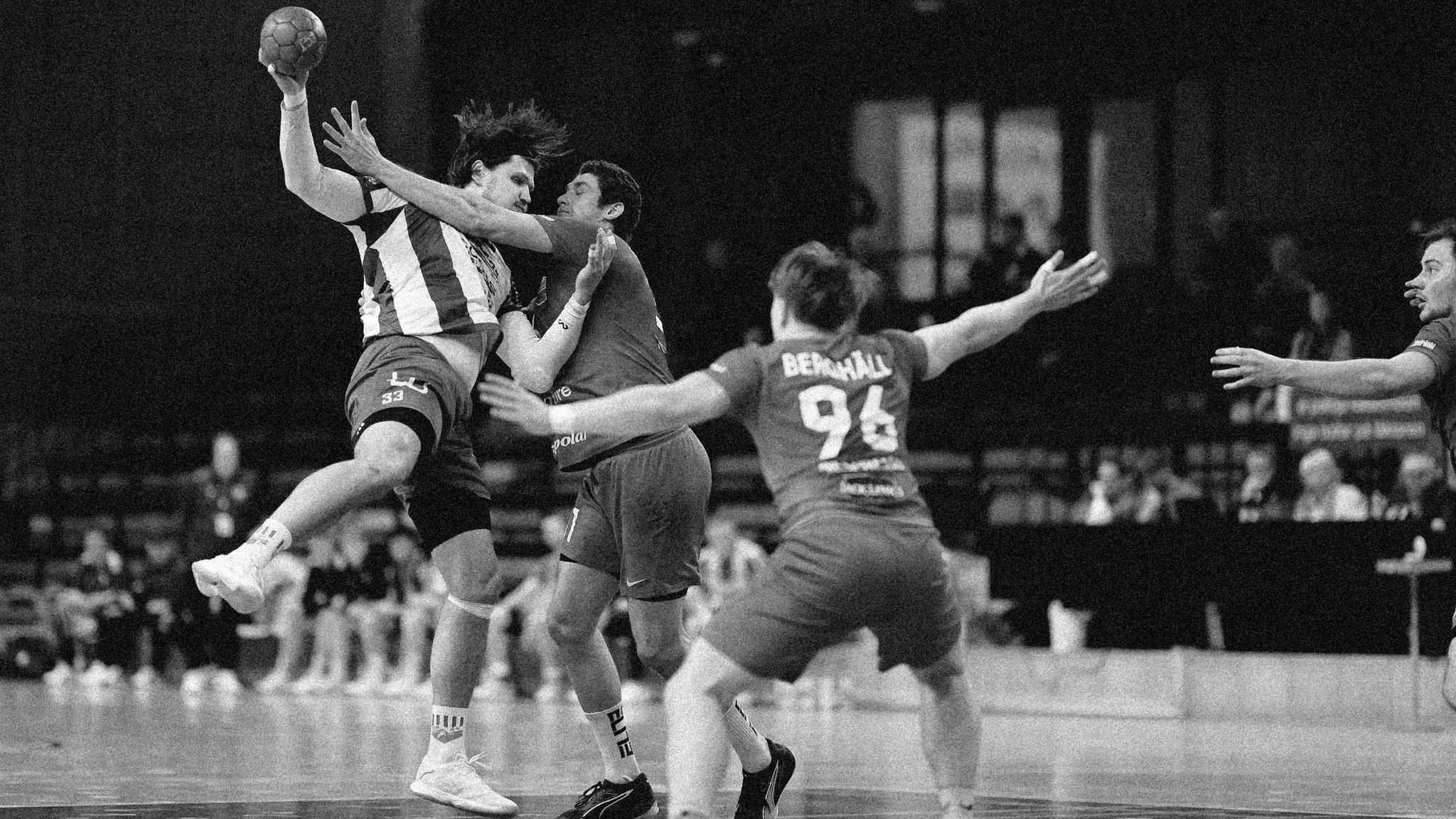
Canon 1D X Mark III + Sigma 105mm f/1.4 A, 1/1600, f1.4, ISO1250
Composition, too, reflects this reality. Handball courts are dense visual spaces where lines intersect, bodies overlap and clarity is rarely absolute. Clean, isolated forms are the exception. Rather than resisting this, it often makes sense to accept the visual congestion and work within it, using layers, partial obstructions and messy movement to document the physical pressure and pace of the game.
Handball exists slightly outside the main commercial spotlight of global sport, and this distance gives it a particular character. The moments feel less performative, less shaped for the camera. For the photographer, the proximity to the game is tangible: the sound of contact, communication, the rhythm of game, but also the momentary silence. When an image works, that closeness is present within it.
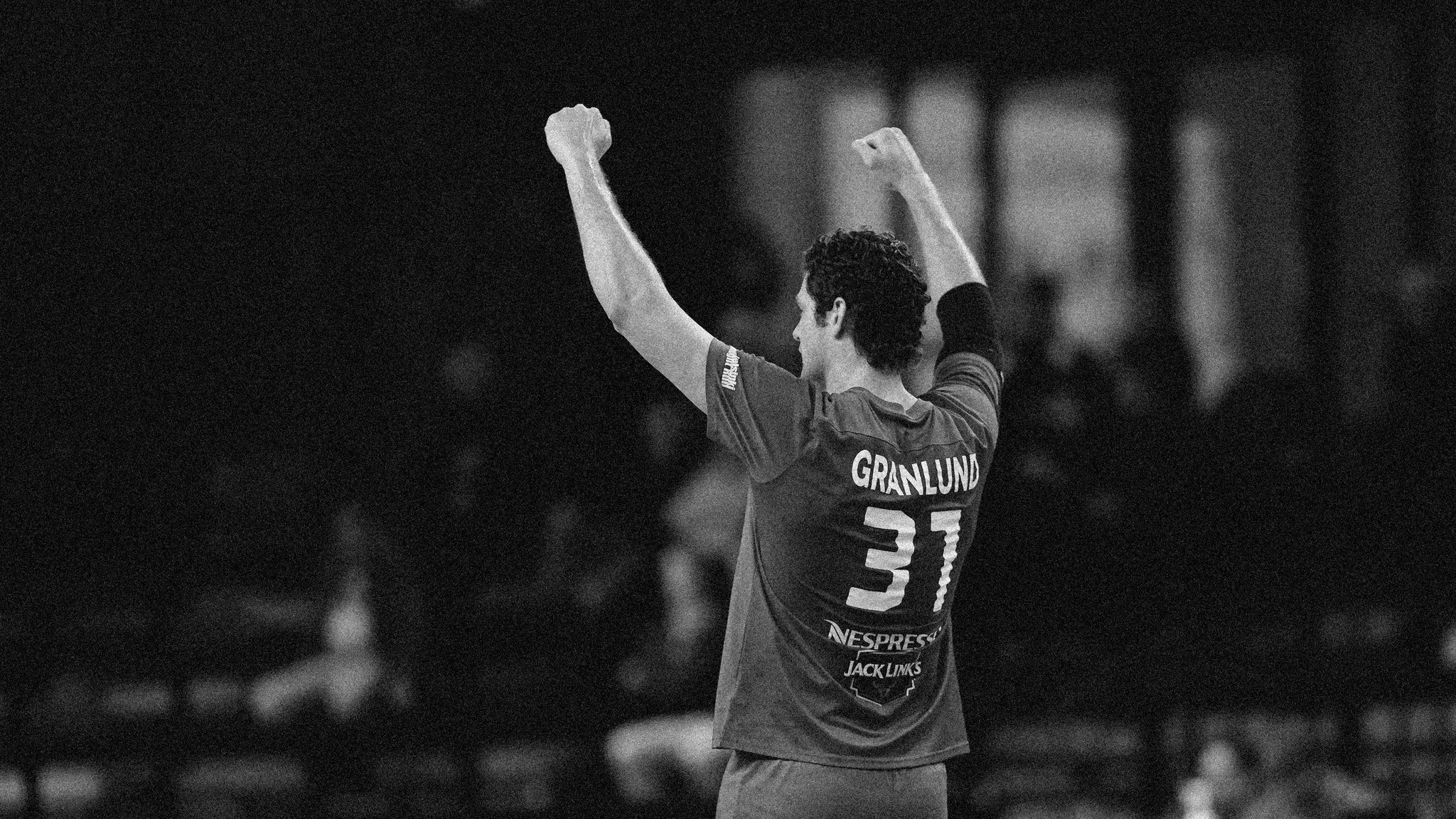
Canon 1D X Mark III + Canon EF 200mm f/2.0L IS USM, 1/1600, f2.0, ISO3200
In the end, handball photography is not defined by equipment or settings, even though both matter and demand precision. Shutter speed, aperture, autofocus and familiarity with the camera are necessary foundations, and without them the work quickly falls apart. But once they are in place, they recede into the background. It is about staying close, close enough to sense when something shifts, when a gesture, a look, or a pause briefly reveals more than the action itself. The photograph does not stop the game or explain it. It offers a fragment, shaped by my attention and timing, that reflects how the game was experienced by me in that moment. What keeps me returning is not the promise of spectacle, but the possibility that, somewhere between two actions, an image will emerge that feels true to the rhythm, the pressure, and the fleeting clarity of handball as it unfolds. I have yet to make a photograph that truly brings all of these elements together, that I would be really happy with, and it is this absence that keeps me sitting court-side.
All images taken 26.1.2026 at the Dicken - BK-46 Finnish Handball League game in Pirkkola, Helsinki, Finland.
